FASHION INDUSTRY
The fashion industry is a globalized sector that works to meet the demand for apparel and dictates the trends for what should be worn. This industry consists of five distinct and separate levels. These levels are haute couture, luxury wear, affordable luxury wear, mainstream clothing, and discount clothing. The production part of the industry, that which takes the concept for a piece of apparel all the way to the hands of those who purchase it, is made up of four basic sectors. These sectors include producers of the goods necessary to make the apparel, those who create the pieces, those who advertise and market the goods, and those who sell the goods.
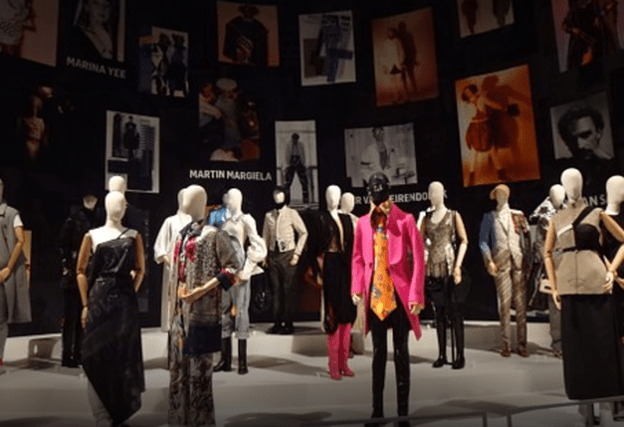
Luxury wear and affordable luxury wear developed from haute couture, but were designed to be marketed to the masses and were not unique creations. These pieces were and continue to be considered high-end apparel that is more costly than the more common ready-to-wear pieces. Luxury wear and affordable luxury are more commonly sold in boutiques and high-end department stores. Oftentimes, the number of pieces available for purchase is limited, which makes the demand greater. While luxury wear and affordable luxury wear are quite similar, their obvious difference is their cost and their availability.
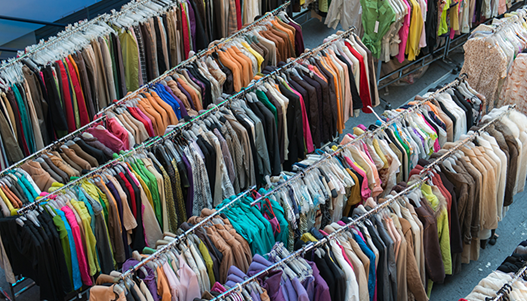
Mainstream clothing is mass marketed. It is set at a decidedly lower price level than designer clothing. It is marketed to the masses. Mainstream clothing is what is known as off the rack clothing. This simply means that the clothing is bought directly from the rack and is entirely a ready-made garment. These ready-made garments vary in quality from one brand to another, but they are decidedly lower in quality than either type of luxury wear.
The fashion industry is unique from other fields of manufacturing in that it is ruled largely by the same intention as its end product: change.
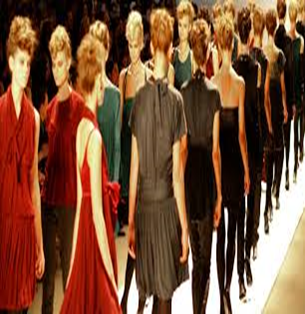
What defines the fashion industry is largely based on the functions of the individuals who comprise it—designers, stores, factory workers, seamstresses, tailors, technically skilled embroiderers, the press, publicists, salespersons, fit models, runway models, couture models, textile manufacturers, pattern makers, and sketch artists. In simplest terms, the fashion industry could be described as the business of making clothes, but that would omit the important distinction between fashion and apparel. Apparel is functional clothing, one of humanity’s basic needs, but fashion incorporates its own prejudices of style, individual taste, and cultural evolution.
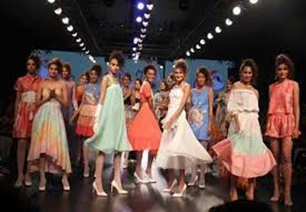
How India’s ascent could change the fashion industry?
The growth in the apparel sector is also being driven by increasing tech savviness among consumers. Ten years ago, technology was for the few, with just five million smartphones in a country of 1.2 billion people and only 45 million Internet users. These figures have since increased to 355 million and 460 million, respectively, in 2018, and they are expected to double by 2021, when more than 900 million Indian consumers will be online.
E-commerce leaders are moving to solutions based on artificial intelligence. “Personalization and curation based on personal taste will become a lot more important,” says Ananth Narayanan, chief executive of Myntra, a fashion e-commerce player acquired by Flipkart in 2014. “It’s not about having the largest selection; it’s about presenting the most appropriate selection to the customer involved.”
In short, the Indian market offers great promise. Despite structural challenges that include inequality, infrastructure, and market fragmentation, we expect that strong economic growth, scale, and rising tech savviness will combine to make the country the next big global opportunity in fashion and apparel.
Key Sectors Of The Fashion Industry
Textile design and production:
Most fashions are made from textiles. The partial automation of the spinning and weaving of wool, cotton, and other natural fibres was one of the first accomplishments of the Industrial Revolution in the 18th century. In the 21st century those processes are highly automated and carried out by computer-controlled high-speed machinery. A large sector of the textile industry produces fabrics for use in apparel. Both natural fibres (such as wool, cotton, silk, and linen) and synthetic fibres are used. A growing interest in sustainable fashion led to greater use of environmentally friendly fibres, such as hemp. High-tech synthetic fabrics confer such properties as moisture wicking, stain resistance , ultraviolet radiation (Solarweave), and other hazards. Fabrics are produced with a wide range of effects through dyeing, weaving, printing, and other manufacturing and finishing processes. Together with fashion forecasters, textile manufacturers work well in advance of the apparel production cycle to create fabrics with colours, textures, and other qualities that anticipate consumer demand.
Fashion Design and Manufacturing:
An important stage in garment production is the translation of the clothing design into a pattern in a range of sizes. Because the proportions of the human body change with increases or decreases in weight, patterns cannot simply be scaled up or down uniformly from a basic template. Pattern making was traditionally a highly skilled profession. In the early 21st century, despite innovations in computer programming, designs in larger sizes are difficult to adjust for every figure. Whatever the size, the pattern—whether drawn on paper or programmed as a set of computer instructions— determines how fabric is cut into the pieces that will be joined to make a garment. For all but the most expensive clothing, fabric cutting is accomplished by computer-guided knives or high-intensity lasers that can cut many layers of fabric at once.
Fashion retailing, marketing, and merchandising:
Once the clothes have been designed and manufactured, they need to be sold. But how are clothes to get from the manufacturer to the customer? The business of buying clothes from manufacturers and selling them to customers is known as retail. Retailers make initial purchases for resale three to six months before the customer is able to buy the clothes in- store.
Fashion marketing is the process of managing the flow of merchandise fromthe initial selection of designs to be produced to the presentation of products to retail customers, with the goal of maximizing a company’s sales and profitability. Successful fashion marketing depends on understanding consumer desire and responding with appropriate products. Marketers use sales tracking data, attention to media coverage, focus groups, and other means of ascertaining consumer preferences to provide feedback to designers and manufacturers about the type and quantity of goods to be produced. Marketers are thus responsible for identifying and defining a fashion producer’s target customers and for responding to the preferences of those customers.
FASHION SHOWS
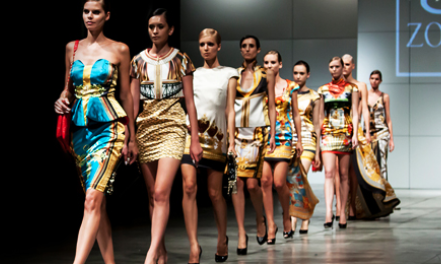
Fashion designers and manufacturers promote their clothes not only to retailers (such as fashion buyers) but also to the media (fashion journalists) and directly to customers. Already in the late 19th century, Paris couture houses began to offer their clients private viewings of the latest fashions. By the early 20th century, not only couture houses but also department stores regularly put on fashion shows with professional models.
MEDIA
The development of effective and inexpensive methods of reproducing photographs in print media in the early 20th century led to the rise of fashion photography and of heavily illustrated fashion magazines such as Vogue. Magazine advertising rapidly became a principal marketing tool for the fashion industry.
The creation of cinema newsreels—short motion pictures of current events— and the rise of television made it possible for people all over the world to see fashion shows and to imitate the fashionable clothing worn by celebrities. The dominance of visual media continued in the Internet age, with fashion blogs emerging as an increasingly important means of disseminating fashion information. Red-carpet events such as awards ceremonies provide an opportunity for celebrities to be photographed wearing designer fashions, thus providing valuable publicity to the designers.
 Lush Life